Skip to content

Network Rail manages one of the most complex infrastructure estates in Britain. Specifically, this includes more than 2,500 stations, thousands of trackside buildings, and millions of individual assets. Because of this massive scale, relying strictly on reactive, like-for-like maintenance is no longer financially viable. Therefore, the network requires a disciplined, long-term plan to govern both routine upkeep and major renewals.

The 4S Framework and Minimum Viable Product (MVP) is Network Rail’s response, aligned to its seven-year control period. Ultimately, this strategy shifts the focus away from short-term fixes. Instead, it prioritizes decisions based on the whole-life cost of an asset.

For a detailed breakdown, you can review these guiding principles in the official Network Rail Design Manual: NR-GN-CIV-200-08 (Lighting Design in Stations).

Furthermore, the RSSB (Rail Safety and Standards Board) has updated RIS-7702 (Lighting for Stations) to strictly account for glare and light spill to protect train drivers and passengers. Combined, these updated standards are fundamentally transforming how lighting and controls are specified across the UK rail network.

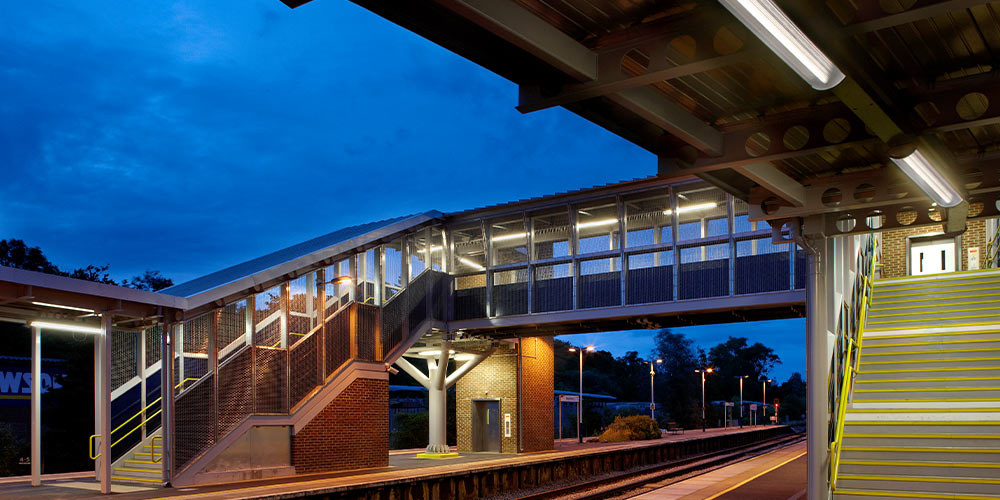
1. Sustainability: Circular Economy & Intelligent Control

Rail is already among the lowest-carbon modes of travel. However, ageing platform lighting still creates an avoidable energy drain. Consequently, current Sustainability Targets require Network Rail to achieve measurable cuts in carbon, energy, and waste across its entire estate.

For modern railway lighting, that ambition reaches well beyond a basic LED retrofit. Two priorities dominate:

  • Intelligent Control: Networked control systems dim luminaires automatically, lowering power output during low-footfall periods without compromising passenger safety or perceived security.
  • Circular Economy Principles: Second, specifiers now favour light fixtures designed specifically for easy disassembly. Consequently, maintenance teams can replace serviceable parts, such as drivers, LED boards, and control gear, right on the platform. Rather than throwing away the entire housing, this approach significantly extends the asset’s life and reduces embodied carbon.

2. Satisfaction: User Comfort & Inclusive Wayfinding

A modern railway is judged by the quality of the journey, rather than just the destination. Accordingly, the Satisfaction pillar focuses on station conditions, commercial environments, and, most importantly, accessibility.

In this context, lighting acts as a silent but powerful guide for passengers. Well-designed platform lighting provides smooth and even illumination. Thus, it eliminates dark shadows and creates a seamless transition between covered areas and open platforms.

To meet these inclusive design standards, modern specifications specifically demand:

  • Adequate vertical lighting alongside a high Colour Rendering Index (CRI). This ensures that passengers can easily read signs, navigate ticket barriers, and spot hazard warnings.
  • In addition, light levels must be optimised so that station CCTV cameras can record clear, reliable security footage.

3. Safety: Controlling Glare & Platform-Edge Risk

Above all, safety is the railway’s top priority. The 4S Framework enforces this through targeted, evidence-based design. On a busy platform, the line between good lighting and a serious hazard is incredibly thin.

Consequently, the main engineering challenge is balancing clear visibility for passengers with complete safety for train drivers. This is exactly where the Zeroglis® external lighting philosophy becomes essential.

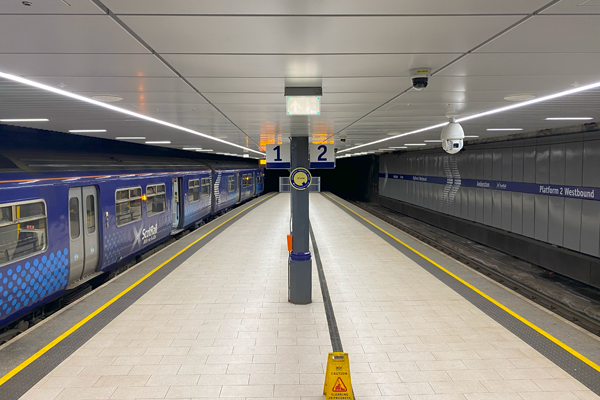
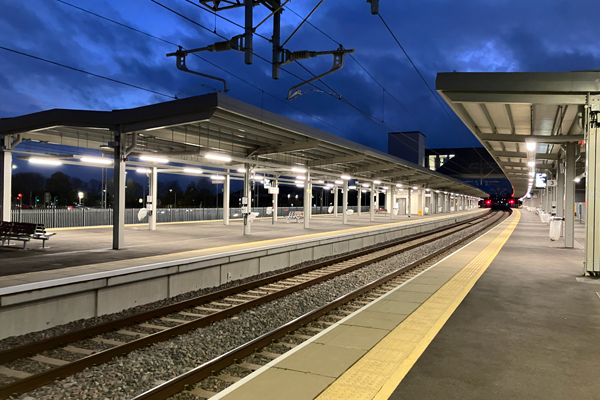
Specifically, Zeroglis® focuses on absolute beam control. Light is directed exactly where it is needed. By using precision optics and shielding, it completely stops light from spilling upward or glaring to the sides. As a result, this prevents stray light from blinding drivers or being confused with trackside signals. Meanwhile, the platform edge remains brightly lit to prevent slips, trips, and falls.

4. Stewardship: Lowering Whole-Life Cost (WLC)

Britain’s railway is deeply historic, Network Rail is the custodian of more than 440 listed buildings and thousands of structures well over a century old. Stewardship is where that custodial duty meets hard commercial logic.

Stewardship evaluates a lighting asset on Whole-Life Cost (WLC), rather than the lowest initial capital price. Because platform environments are punishing, specifiers look for specific structural resilience metrics:

Asset Requirement Specification Standard
Environmental Protection High IP (Ingress Protection) rating
Vandalism Resistance High IK (Impact Protection) rating
Operational Lifespan Rated life extending beyond 100,000 hours

The New Specification Test

Under the 4S framework, lowest price alone no longer qualifies a project. Every luminaire on a platform must now explicitly prove four things:

  1. Sustainable: Built for the circular economy with smart dimming.
  2. Comfortable: Clear and inclusive for passenger wayfinding.
  3. Glare-Free: Safe for train drivers and signals.
  4. Durable: Resilient enough to protect public spending for generations.

FAQs

What is the Network Rail 4S Framework?

The 4S Framework is a procurement and design strategy used by Network Rail to govern asset maintenance and renewals. It stands for Sustainability, Satisfaction, Safety, and Stewardship. The framework shifts the rail network away from short-term, low-cost fixes toward intelligent, whole-life cost (WLC) decisions.

What is the NR-GN-CIV-200-08 standard?

NR-GN-CIV-200-08 is Network Rail’s official design manual and guidance note for lighting design in stations. It outlines the technical criteria specifiers and engineers must meet regarding asset lifespan, energy efficiency, and passenger comfort across UK railway platforms.

How does the RIS-7702 standard protect train drivers?

The Rail Safety and Standards Board (RSSB) standard RIS-7702 governs lighting for stations. The updated standard focuses heavily on controlling light spill and glare. By requiring precision optics, it ensures platform lighting does not dazzle train drivers or accidentally mimic trackside signals, while still maintaining high visibility for passengers at the platform edge.

What are circular economy lighting principles in rail infrastructure?

In rail infrastructure, circular economy lighting involves specifying luminaires designed for easy disassembly. Instead of replacing an entire lighting fixture when a part fails, maintenance teams can replace individual components, like LED boards, drivers, or control gear, in situ. This reduces raw material waste, lowers embodied carbon, and extends asset lifespan.

What lighting specifications are required for Network Rail platforms?

To withstand harsh environments, Network Rail platform lighting specifications look for high IP (Ingress Protection) and high IK (Impact Protection) ratings. Luminaires must feature high illuminance uniformity, adequate vertical illuminance, a high Colour Rendering Index (CRI) for inclusive wayfinding, and an operational lifespan extending beyond 100,000 hours.

Our lighting guide identifies typical overground rail applications. We examine the benefits of robust construction and lighting controls to reduce your cost of ownership and carbon footprint. To download your copy click on the button below.

railway lighting, platform lighting

You can also connect with us on LinkedIn and Instagram for ongoing updates.

;